DHARMA ON THE GO
-Short clips for those looking for
quick teachings
Who
is Geshe Tenzin Zopa? Introduction..
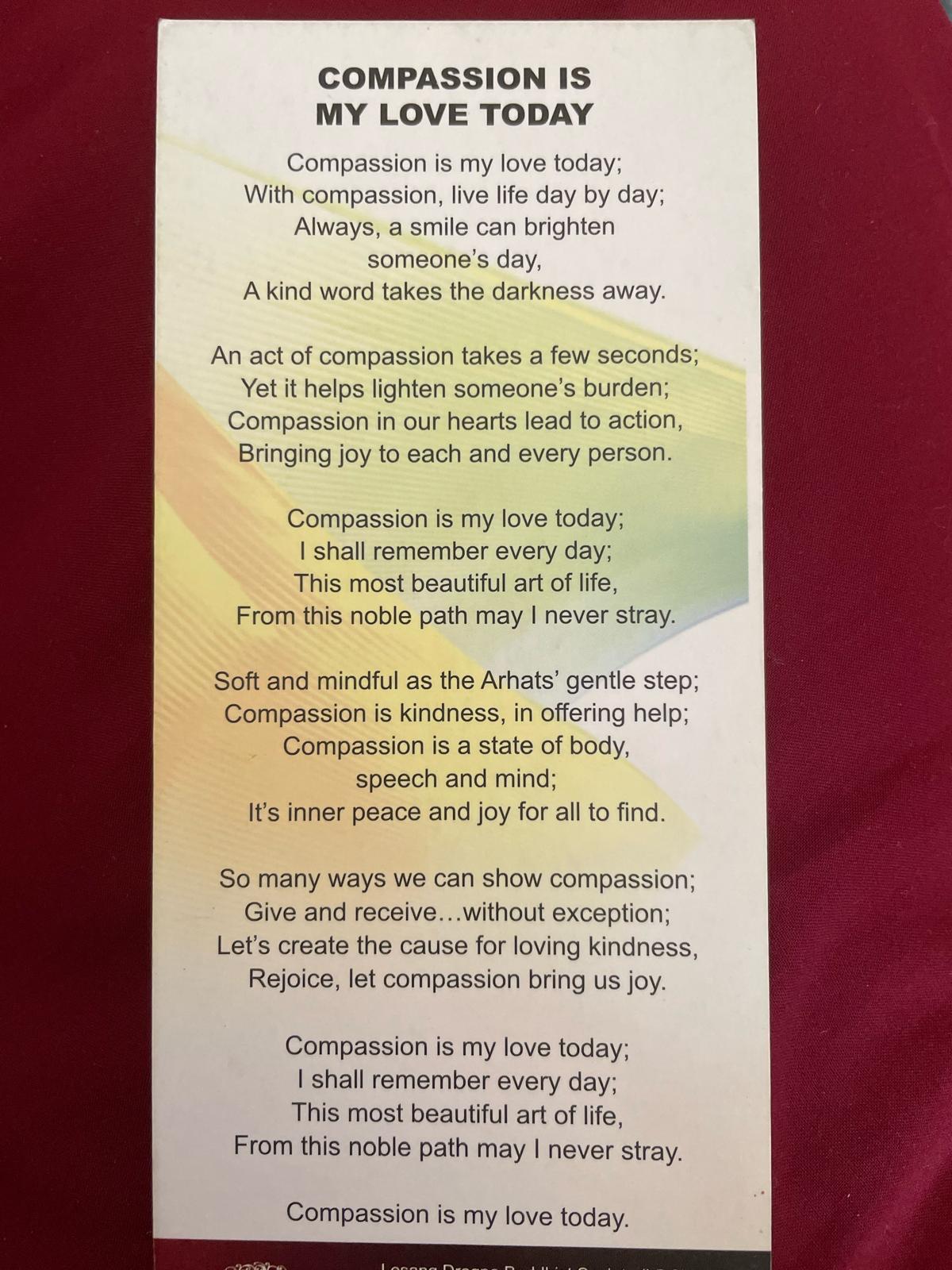
Compassion is My Life Today (English) (Mandarin) -Lyrics / Poem by Geshe Zopa
Buddha/Guru
Guru Rinpoche Prayers (Sampa Lhundrubma-English text) and Seven line prayer to eliminate obstacles (25.05)- Text
Awakening within your pre existent Buddha nature
Buddha Chenrezig/Kuan Yin and Dzambhala
Bodhisattva Namtose (Dharma Protector)
Medicine
Buddha , the Healing Buddha
Namgyalma , the long life deity
Foundation on all
Good Qualities(on Guru)
Who is Arya Avalokiteshvara Simhanada? (Mantra)
Vajrsattva /Dorje Sempa (Mantra)** Power of reciting Vajrasattva mantra
-Vajrasattva Retreat as one of the 4 great Ngondro/(5.40) Explanation of the long Vajrasattva mantra
Why is the topic on Guru devotion important?
Vajrayogini is the direct antidote to desire
The Raining /Bestowing Wisdom Mantra
Who is TARA and why is there 21 Taras
Dying and Death
Remembering the Guru at the time of death- the switch to take the clear light onto the path
We can die peacefully and wisely if..
Karma
How
to benefit others with prayers /dedications (while karma is individual)
Karma
of killing one ant equals to.....
Individual
karma or collective karma?
Lam Rim /Lojong
Acknowledging and purifying negative karma
Tara-
Enlightenment is possible....
How
quickly can we achieve enlightenment would depend on.....
Why i was happy with
nothing but miserable with everything
Dealing with difficult parents
How to eliminate the false 'I'?
How would i know if i am on the right path?
Find your Self, not lose your Self
Tong len pratice- an antidote?
Forgiveness through the eyes of compassion
Enlightenment is nothing more than .......
Why prayers dont work at times
We have an opportunity to be a sangha in our hearts
The meaning of life-Happiness, service and devotion
What to study after taking refuge? Three tipitakas (Three Baskets of teachings)
Ngon dro
What
is Ngon dro and its purpose
Oral Transmission
Difference between initiation, oral transmission, vows, jenang and requirements
Short Lamrim and Lam rim prayers
Buddha Maitreya, (3.10)Explanations and Oral transmission of Mantra***
Benefits of seeing holy objects +Oral transmission of the long Chenrezig Dharani*
Preliminary Practice
Meaning of Heart Sutra mantra (in audio) (Text)
Why
Tibetans spin Prayer wheel?
What is the first move not to fall into 3 lower realms?
What and why offer mandala and handmudras? Part 1 Part 2
Why are we still swirling in negativity? (Vajrasattva practice)
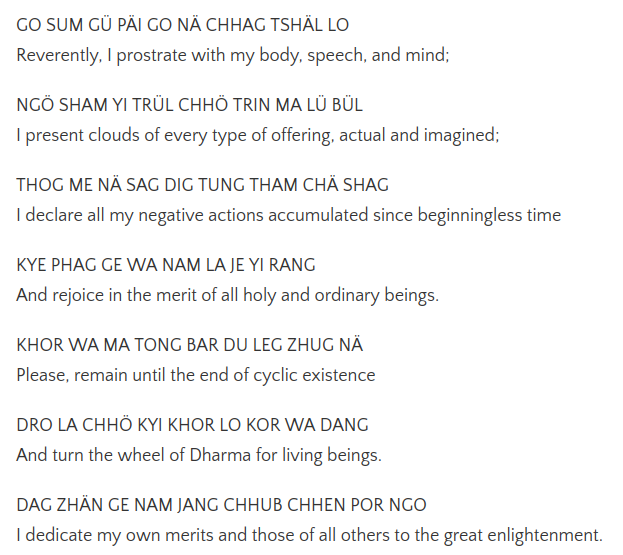
Seven Limb Prayers Part 1 2 3 PRAYER TEXT
( 1. Limbs of Prostrations/2. Limbs of Offering/3. Limbs of Confession/4.Limbs of Rejoicing
5.Limbs of requesting Guru to remain and turn the wheel of Dharma/6.Limbs of requesting the guru to have a long life/7. Dedication)
Three Principle Aspect of the Path Part 1 2 (TEXT)
(1.Bodhichitta 2. Renunciation 3. Wisdom realizing emptiness )
Thirty Seven Practices of a Bodhisattva Part 1
- Summary of 37 practices of a Bodhisattva (refer to EBook section for further reading)
Refuge
Do i have to take refuge if i am from a different faith?
To take or not to take refuge and why take refuge....
What is the precept of taking refuge?
Reincarnation
Finding the Reincarnation- A 5 year search
Recognizing Phuntsok Rinpoche as the reincarnation of Geshe Lama Konchog
Who's who
The 17 Nalanda Pandits from Nalanda Monastery :-
1. Nagarjuna (c. 2nd century C.E.), the revealer of the Perfection of Wisdom Sutras and the systematizer and founder of the Middle Way (Madhyamaka) school of Buddhist philosophy, The Fundamental Wisdom of the Middle Way, probably the single most analyzed, commented upon and discussed philosophical treatise in Buddhism’s history.
2. Aryadeva
(c. 3rd century C.E.) who is sometimes referred to as Nagarjuna’s heart
disciple and sometimes simply as his first authoritative commentator.
Like Nagarjuna, Aryadeva is universally revered as an authoritative
voice for all subsequent Middle Way commentators and is most well known
for his treatise The Four Hundred Stanzas.
3. Asanga (300-390 C.E.), the founder and masters of the Mind Only school (Yogachara/Chittamatra) and
4. Vasubandhu (c. 4th century C.E.) disciple and half brother of Asanga - both are the earliest and most authoritative commentators. In addition to his own treatises, Asanga is also famous for retrieving the five Maitreya Buddha texts directly from Maitreya in his pure land, Tushita. He also wrote a famous treatise from the perspective of the Great Exposition school (Vaibhashika) entitled The Treasure of Knowledge (Abhidharmakosha) which is utilized extensively in Tibetan scholastic studies.
5. Dignaga (6th century C.E.) and ..
6. Dharmakirti
(600-660 C.E.). They are most famous as the groundbreakers in
Buddhist logic and epistemology.Tthey wrote philosophical
treatises on the contents and means of accruing valid knowledge. They
argued that from the Buddhist perspective there were two sources of
valid knowledge: logical inference and direct perception. Much of their
writings were detailed elaborations on these topics.
7. Gunaprabha (c. 9th century C.E.) and ..
8. Shakyaprabha. Two great vinaya masters. Gunaprabha was a disciple of Vasubandhu’s and is most famous for his treatise, the Vinayasutra. Shakyaprabha was a disciple of Shantarakshita’s (also among the seventeen) and the other major teacher of vinaya among the seventeen. He is particularly associated Mulasarvastivada-vinaya line which has been followed in Tibet since the time of the early Dharma King, Ralpachen (born c. 806 C.E.).
9. Buddhapalita (470-550 C.E.) was one of the great commentators on Nagarjuna’s Madhyamaka thought. He is the earliest Indian Madhyamika specifically identified as a proponent of the sub-school of Madhyamaka known in Tibet as the Middle Way Consequence school (Prasangika-Madhyamaka). He received this designation in Tibet due to his use of a form of reasoning that drew out the absurd logical consequences of the philosophical rivals of Madhyamikas when he commented on Nagarjuna’s root text on wisdom.
10. Bhavaviveka (500-578 C.E.). He argued that a proper Madhyamaka commentator ought to do more than show the absurdities of other’s views; they also have a responsibility to establish the view of emptiness and to do so with autonomous inferences (svatantranumana). He subsequently became known in Tibet as the “founder” and primary proponent of a sub-school of Madhyamaka known as the Middle Way Autonomy school (Svatantrika-Madhyamaka).
11. Chandrakirti (600-650 C.E.) -the founder of the Middle Way Consequence school, often regarded as
the highest Buddhist philosophical explanation of reality. In a line of thinking further developed by Je
Tsongkhapa (1357-1419 CE) they argued that a Madhyamaka philosopher
ought not to utilize autonomous inferences because the very use of that
sort of reasoning entailed the acceptance of an inherent nature in the
subject of the argument. His views on a proper understanding of Madhyamaka
began to dominate the philosophical landscape and continue to today.
12. Shantarakshita (725-788 C.E.). He is famous for integrating the three major lines of
Mahayana philosophy into an integrated coherent system. These were the
Madhyamaka, the Yogachara and the logico-epistemological thought of
Dharmakirti. Beyond India, He served as the abbot of it first
monastery. Shantarakshita virtually taught Tibetans how to do
philosophy during the early dissemination of the Dharma there.
13. Kamalashila (c. 8th century C.E.) , a disciple of Shantarakshita likewise was an immensely important figure in India and Tibet. Like his teacher, Kamalashila wrote extensively on Madhyamaka and pramana (logic and epistemology) as well as on meditation theory and practice. His three Stages of Meditation (Bhavanakrama) texts are among the most cited in traditional Tibet expositions on the topics.
14. Haribhadra (700-770 C.E.), the last of Shantarakshita’s disciple wrote the most famous and commonly utilized of the 21 Indian commentaries on The Ornament of Clear Realizations by Maitreya and the Mahayana path system in general.
15. Vimuktisena (c. 6th century C.E.) another commentator on the Ornament of Clear realizations , whose text Illuminating the Twenty Thousand: A Commentary on the Ornament is likewise extensively cited by subsequent Tibetan authors.
16. Shantideva (c. 8th century C.E.) composed what is
perhaps the most important and influential classic on how to practice in
the Mahayana tradition: A Guide to the Bodhisattva’s Way of Life (Bodhisattvacaryavatara) while a monk at Nalanda. His text on the development of bodhichitta
and the practice of the six perfections is revered and studied
extensively by all Tibetan traditions. His Holiness the Dalai Lama often
refers to his favorite passage in Buddhist literature as coming from
the dedication section of this text: “As long as space endures, as long
as sentient being remain, may I too remain, to dispel the miseries of
the world.”
17. Atisha (980-1054 C.E.),a Bengali scholar who was a critical figure in the later dissemination of Buddhism in Tibet. His classic, The Lamp for the Path to Enlightenment (Bodhipathpradipa) is widely regarded as the root text on the graduated stages of the path presentation found in Tibetan classics like Je Tsongkhapa’s The Great Treatise on the Stages of the Path to Enlightenment (also commonly referred to by the abbreviated Tibetan name, Lamrim Chenmo), Gampopa’s Jeweled Ornament of Liberation and Patrul Rinpoche’s The Words of My Perfect Teacher among others. In addition to the stages of the path teachings, Atisha also introduced the lojong, or mind training, tradition of Mahayana practice in Tibet. Lojong teachings are quintessential Mahayana teachings in that their aim is to eliminate both the self-cherishing attitude and self-grasping by teaching means to cultivate the altruistic compassion of bodhichitta and the direct realization of emptiness. Like the stages of the path teachings, the mind training tradition is one that is embraced by all Tibetan lineages.
(How
to construct a 3 tier mandala)
Short Mandala Offering Mantra
Sa zhi pö kyi jug shing me tog tram
(This ground, anointed with perfume, strewn with flowers,)
Ri rab ling zhi nyi dä gyän pa di
(Adorned with Mount Meru, four continents, the sun and
the moon.)
Sang gyä zhing du mig te ül wa yi
(I imagine this as a buddha-field and offer it.)
Dro kün nam dag zhing la chö par shog
(May all living beings enjoy this pure land!)
Mantras
Shakyamuni Buddha's Mantra (Tadyatha Om Mune Mune Maha Muneye Svaha)Lama
Zopa Rinpoche name mantra -
Om Ah Guru Vajradhara Muni Shasana
Kshanti Siddhi Hum Hum
Green
tara (Om Tare Tutara Ture Soha)
Mig me tse wai ter chhen Chenresig/Dri me khyen pai wang po jam pai yan/
Du pung ma lu jom dza sang wai dag/ gang chan kha pa tsong gyan tsong kha pa
Lo zang drag pa zhab la sol wan deb )
Tayata Om Bekandze Bekandze Maha
Bekandze Bekandze Randze Samungate Soha
Sang gya chho shog kyi chhog nam la/Jang chhub bar du dag ni kyab su chi/
Dag gi jin sog gyi pa so nam gyi/Dro
la phan chhir sang gya drub par shog
OM AH HUM VAJRA GURU PÄDMA SIDDHI
HUM
Ah Ka Sa Ma Ra Tsa Sha Da Ra Sa Ma Ra Ya Phat- dispel obstacles /hindrances
Essence
of Vajra Cutter Sutra mantra (Teachings plus oral transmission)
'Namo Bhagawate Prajna Paramitaye Om
Natetita
Ilishi Ilishi Milishi Milishi Bhinayan Bhinayan Namo
Bhagawate Pratyam Prati Iriti Iriti Miriti Miriti
Shuriti Shuriti Ushuri Ushuri Bhuyuye Bhuyuye Soha'
Reciting this mantra once is equivalent to 90 million
times recitations of the Vajra Cutter Sutra.